The College Backs punting route, landmark by landmark
A standard trip from Quayside runs upstream past the principal river-facing colleges and some of Cambridge's best-known bridges. This guide follows them in the order you meet them.
The route at a glance
A College Backs trip typically takes about 45 to 50 minutes there and back and passes around seven colleges and nine bridges. Counts vary depending on where a publisher draws the route boundary, and exact routes and timings vary by operator and river traffic. The sights below are listed in the order a passenger leaving Quayside sees them.
Before the colleges: a working bank
It takes some imagining now, but this stretch was once a place of work. Under Edward I a run of wharves lined the bank between the Great Bridge and the Small Bridges, now Silver Street. Flaxhythe, Cornhythe and Salthythe were among them. You may also hear that barge horses, banned from college land, waded along a submerged towpath here. We haven't traced that story to an early source. There's more on the working river page.
1. Magdalene College and the Great Bridge
The trip begins beside Magdalene Bridge, the cast-iron span of 1823 at Cambridge's oldest river crossing. Magdalene College stands on the water's edge. What to notice: the single iron span and the railings ending at stone piers.
2. St John's College and the Bridge of Sighs
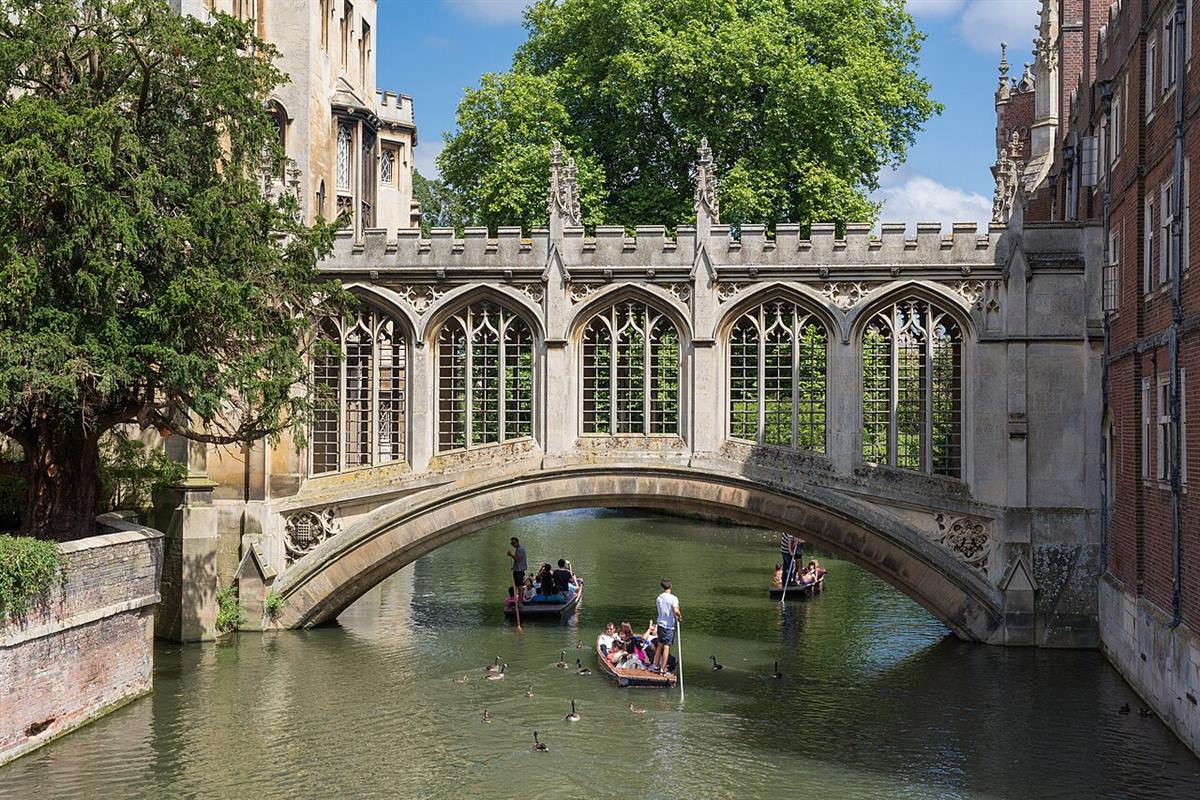
The covered Bridge of Sighs was designed by Henry Hutchinson in 1827 and completed in 1831, when it was simply the New Bridge. The college links its famous name to a remark by Queen Victoria in 1847, and notes that most commentators doubt it really looks like the bridge in Venice. About 20 metres upstream is the Kitchen Bridge, also called the Wren Bridge, built between 1709 and 1713 to designs by Christopher Wren, with Robert Grumbold overseeing the work. What to notice: the contrast between the covered bridge and the open one just beyond it.
3. Trinity College and the Wren Library
Trinity Bridge, built in 1764 and 1765 to a design by James Essex, is Grade I listed. Beyond it is the Wren Library, built from 1676 to 1695. Wren gave his design without charge, at the request of Trinity's Master, Isaac Barrow. What to notice: the library's long river elevation.
4. Trinity Hall
Trinity Hall sits beside Trinity and Clare, with gardens that run down to the river. What to notice: how close the college buildings and lawns come to the water.
5. Clare College and Clare Bridge
Clare Bridge, completed in 1640 and credited to Thomas Grumbold, is Grade I listed and the oldest of the college bridges on the Backs. What to notice: the stone bridge and the college garden behind it.
6. King's College and the Chapel
King's College Chapel rises above the lawns running down to the river. Its first stone is traditionally dated to 1446, a date the college notes is disputed, and the building was finished in 1515. King's Bridge, designed by William Wilkins, is much younger, dating from about 1819. What to notice: the chapel's height against the open grass.
7. Queens' College and the Mathematical Bridge
The route reaches the Mathematical Bridge at Queens', which links the two halves of the college across the Cam. It was designed by William Etheridge in 1748 and built in 1749 by James Essex the Younger. The bridge you see today is the 1905 rebuild in teak. What to notice: the bridge's timber structure.
You may hear that Isaac Newton built it without nails, and that it could not be reassembled after students took it apart. The college's history site rejects this: Newton died in 1727, more than 20 years before the bridge existed, and the bridge has had fastenings from the start.
Then back to Quayside
Chauffeured trips normally return along the same stretch to the starting station. Whether a trip goes the full length of the Backs depends on the operator and the conditions on the river.
For tips on what to wear, how to choose between chauffeured and self-hire, and typical prices, see the punting guide. Steering yourself? Read how to punt. To compare all six licensed stations, see the punting stations guide.
Sources: St John's College, Bridge of Sighs; Trinity College Library; British Listed Buildings, Clare Bridge; The Great Britain Guide, Trinity Bridge; King's College Chapel; Royal Commission on Historical Monuments, King's Bridge; Queens' College, Mathematical Bridge. Checked October 2026.
Plan your visit
Routes, timings and which sights are included change between operators and with water levels and traffic. Ask your operator which stretch of the Backs your trip covers.
Information checked October 2026.
Frequently asked
No. Newton died in 1727, and the bridge was built in 1749. The present bridge is a rebuild of 1905.
A typical chauffeured trip takes about 45 to 50 minutes there and back. The time depends on the operator and river traffic.
A standard trip passes about seven colleges and nine bridges. Exact counts vary according to where the route boundary is drawn.
It is the covered bridge at St John's College, completed in 1831.
Ready to plan your trip?
Options, typical prices and practical tips.