Castle Mound: the last earthwork of Cambridge Castle
A grassy mound north of the river that links Iron Age and Roman Cambridge to the Norman castle, and gives one of the city's few panoramic public views.
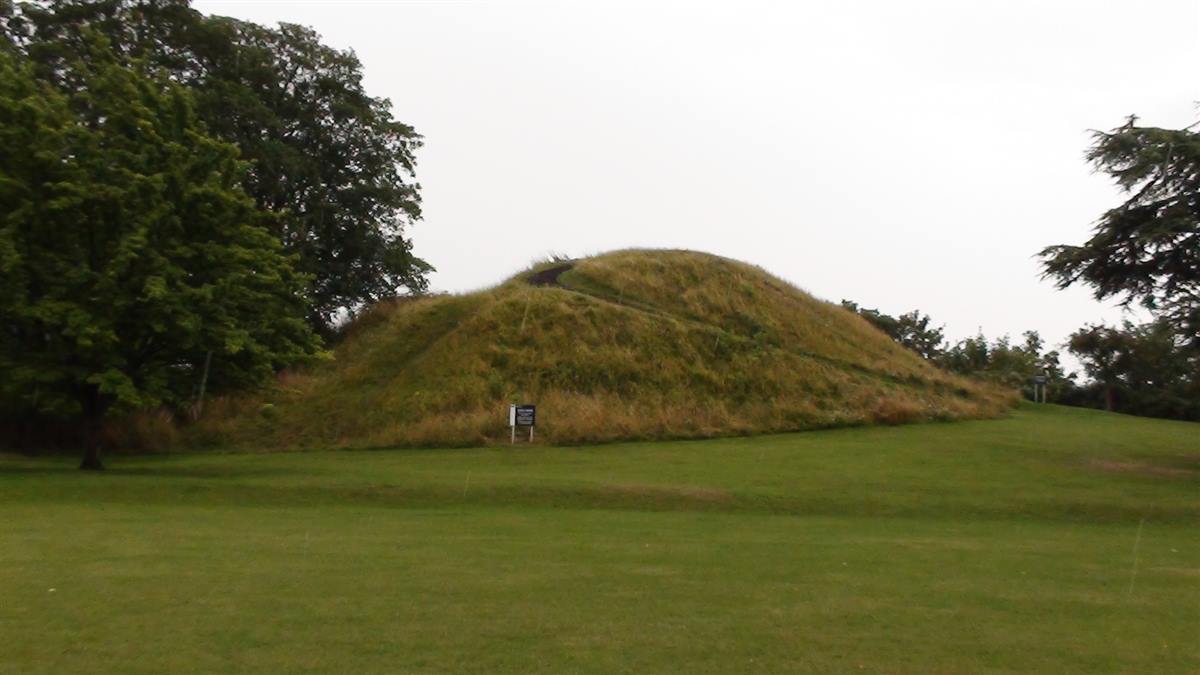
What Castle Mound is
Castle Mound is the motte of the castle that William I ordered in 1068, built from chalk rubble. It is not a natural hill. It is protected as a scheduled monument and is the clearest surviving element of Cambridge Castle.
Before the Normans
Archaeology shows occupation on Castle Hill for more than 2,000 years, including a late Iron Age enclosure. A small Roman fort may have been established around AD 60 and 61, followed by Roman settlement on the hill. The hill sits close to the river crossing now spanned by Magdalene Bridge.
William's castle, 1068
Domesday Book records that 27 houses were demolished to make way for the motte-and-bailey castle. The motte probably supported a wooden keep, although no archaeological trace of that keep has been found.
Motte and bailey explained
A motte is the raised mound carrying the main defensive tower. The bailey is the fortified enclosure beside it, where the castle's buildings stood.
Edward I's stone castle
Edward I substantially rebuilt the castle in stone between the 1280s and the 1290s, adding major defences and buildings. By the later Middle Ages it was declining, although the site continued to serve government, judicial and prison functions.
The Civil War
Parliamentary forces refortified the site during the Civil War. The castle was decommissioned in 1647, and later prison and county buildings occupied the area.
The view from the top
Cambridge City Council describes the mound as rising to about 32 metres above ordnance datum and offering the city's only significant panoramic public view. From the top you can look out across the rooftops of the historic centre.
Walking from Quayside
Cross Magdalene Bridge and continue along Magdalene Street and Castle Street. Kettle's Yard is on Castle Street too, so the two make a compact outing together.
Accessibility and safety
The climb is an incline on a path and can be slippery in wet weather. Wear secure shoes, and check access conditions if you have mobility needs.
Sources: Cambridge City Council, Historic Core Appraisal, The Historical Development of Cambridge; scheduled monument records; Domesday Book. Checked October 2026.
Plan your visit
Castle Mound is an outdoor site, so access depends on the weather and on any conservation or building work nearby. Look for notices on site before you climb.
Information checked October 2026.
Frequently asked
No. It is the surviving motte of the Norman castle, built after 1068, and it stands on Castle Hill, where earlier settlement existed.
The mound and some earthworks are the clearest survivals. The castle was decommissioned in 1647, and later buildings occupied the site.
A panoramic view across the rooftops of Cambridge. The council describes it as the city's only significant panoramic public view.
Combine it with Kettle's Yard
Two stops on the north side of the river, a short walk from Quayside.